Loading samples into SLICE
Overview
Cleared-tissue specimens must be immobilized inside a SLICE Cuvette, containing mounting medium and sealed with a SLICE Cuvette quick-release mount in order to image them on a SLICE system. Position and immobilize the sample inside the cuvette using a MBF Bioscience Mounting Bracket, then submerge in storage solution (that is compatible with the clearing method used to prepare the sample) to maintain clarity and prevent drift during imaging. It is not strictly required to use a mounting bracket, however, they enable convenient tissue handling and stable positioning. A thin layer of silicone sealant applied at the cuvette‑mount junction can prevent mounting medium from evaporating and is recommended for imaging and storing samples. Once assembled, secure the sealed cuvette onto the SLICE microscope stage; SLICE Cuvette quick-release mounts are stably held on the stage by magnets.
Chemical risks to people and equipment
Employ chemical-safety precautions when handling cleared tissue or tissue storage solution. Wear personal protective equipment appropriate for the chemicals present in your cleared specimen.
-
Chemicals used in tissue-clearing protocols may be hazardous, volatile, and corrosive. To minimize risk, we highly recommend that you seal the cuvette with chemically compatible adhesive or sealant after mounting samples.
-
Some tissue clearing methods are not designed for storage exceeding a week, as prolonged exposure to oxidation byproducts of mounting medium will quench fluorophores and break down tissue integrity. The strong solvent itself can also compromise adhesives and mounting stability. For this reason, sample quality inside sealed cuvettes cannot be preserved permanently.
-
Note that some of these chemicals may also be destructive to SLICE hardware. Avoid spilling or dripping chemical material on the instrument; clean up immediately if spills or drips do occur.
Potential chemical risks
| Clearing Method | Chemical | Concerns |
| iDISCO | Dibenzyl Ether (DBE) | Combustible liquid with moderate volatility. Can form peroxides over time when exposed to air and light |
| iDISCO | Ethyl Cinnamate (ECi) | A less toxic and less volatile alternative for DBE, but a potential skin and eye irritant. |
| SHANEL / BABB | Benzyl Alcohol / Benzyl Benzoate (BABB) | Highly volatile and emits a harsh odor. |
| BINAREE | Mounting solution | Classified as non-toxic but evaporation can shift the refractive index and deteriorate imaging quality. |
Required materials
-
MBF Bioscience SLICE Cuvette (any size) containing the following:
-
Fused quartz glass cuvette
-
SLICE quick-release coupling mount: the coupling mount is the lid for the cuvette that both seals it and magnetically connects the cuvette to the SLICE stage.
-
MBF Bioscience Mounting Bracket
-
-
Cleared-tissue specimen, sized to fit in the cuvette. Compatible clearing methods include iDISCO, CLARITY, SHANEL, CUBIC, BINAREE and other optical clearing techniques.
-
Mounting medium appropriate for the tissue-clearing method: the sample will be submerged in mounting medium for short-term storage (<1 week) and imaging.
-
Adhesive for mounting the sample and sealing it in the cuvette. We have used this clear silicone sealant with many clearing techniques, but it is crucial to use an adhesive that is chemically compatible with your clearing reagents and storage medium.
-
Syringe for applying a small amount of adhesive at target position precisely. We have used this product.
-
Tweezers with rubber tips for handling specimen and mounting bracket. We have used this product.
-
(optional) Thin, heat resistant, transparent, silicone sheet, cut into slices that fit into the cuvette you will be using. We have used this product.
-
Safety gear and supplies, including personal protective equipment (PPE), appropriate for the clearing method used for sample preparation and storage.
For SLICE supplies, visit the MBF Bioscience store.
Reuse of cuvette
Although the fused quartz glass cuvettes in the SLICE system are physically durable enough to undergo multiple runs, we highly recommend using a new cuvette for every sample. Light-sheet imaging is highly sensitive to the environment surrounding a sample, and reuse of a cuvette compromises it through the following factors:
-
Residual reagents, fluorophores, or tissue debris from previous experiments often adhere to the inner walls. These remnants can contaminate subsequent samples, leading to unexpected artifacts or chemical interference.
-
Cleaning cuvettes can potentially introduce scratches and etching on the inner surface. Even minor abrasions block the light sheet, resulting in shadowing artifacts.
-
To facilitate reuse, users often avoid permanent adhesives. However, without a proper seal, volatile components in the mounting medium can evaporate. This not only creates potential safety hazards but also alters the sample condition.
If reusing a cuvette is necessary for your workflow, please minimize the risks by thoroughly cleaning and drying the cuvette and preventing any scratches and etching during handling. Click here to see a short video of cuvette cleaning techniques.
Sample loading procedure
Click below to view a short video of loading sample into a cuvette and mounting it onto the SLICE stage.
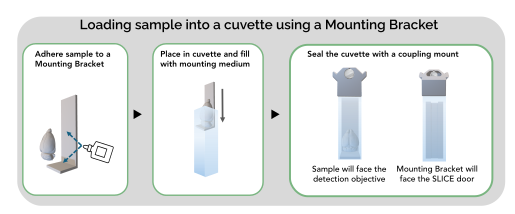
A. Use a mounting bracket to place sample in the cuvette
-
Attach cleared tissue to an MBF Bioscience Mounting Bracket as follows:
-
Gently remove storage solution from cleared tissue using a lint-free tissue.
-
Lint or dust on the surface of the tissue can block the light sheet from illuminating tissue properly, causing shadowing artifacts during imaging.
-
-
Use syringe to apply small amount of adhesive to the bottom and back surfaces of the mounting bracket.
-
Even though the adhesive looks transparent, any trapped air bubbles can cause light refraction and degrade image quality. Please be careful to apply the adhesive only at the contact point with the mounting bracket and keep other areas clear.
-
-
Position the cleared tissue onto the adhesive in the desired orientation.
-
Apply gentle pressure for 5 minutes to secure the tissue.
-
Allow to dry for 1 hour until cured.
-
-
Insert mounting bracket into cuvette and add mounting medium to cover the sample:
-
(optional) Use syringe to apply small amount of adhesive to the bottom of the cuvette. This can help immobilize the sample.
-
If manufacturing variations cause the cuvette's inner size to be larger than expected, applying adhesive to the mounting bracket will prevent drift during imaging.
-
-
Use rubber tipped tweezers to gently insert the mounting bracket into the cuvette and settle it fully at the bottom.
-
Be careful not to scratch the inner surface of the cuvette, as scratches can block the light sheet and introduce imaging artifacts.
-
-
Fill the cuvette with mounting medium until tissue is fully immersed.
-
Remove any bubbles that may have formed in the cuvette using a pipette and wipe away any mounting medium on the exterior of the cuvette.
-
Any trapped air bubbles around the tissue can cause light refraction and degrade image quality.
-
-
alt A. Place sample in the cuvette without using a mounting bracket
-
Place the tissue into the cuvette as follows:
-
Add a small amount of mounting medium to the bottom of the cuvette.
-
Use rubber-tipped tweezers to carefully place the sample into the cuvette.
-
Gently push the tissue toward the side of the cuvette that will face the detection objective and adjust its orientation for imaging.
-
-
Add pieces of silicone sheet to immobilize the tissue and add mounting medium to cover the sample:
-
Stack several silicone slices to form a block that will fill the space between the tissue and the cuvette surface opposite the detection objective.
-
Trim the silicone slices so that the block fits into the cuvette without scratching it.
-
Use rubber-tipped tweezers to insert the trimmed silicone block into the cuvette to hold the tissue in position.
-
Be careful not to scratch the inner surface of the cuvette, as scratches can block the light sheet and introduce imaging artifacts.
-
-
Remove any bubbles that may have formed in the cuvette using a pipette and wipe away any mounting medium on the exterior of the cuvette.
-
Any trapped air bubbles around the tissue can cause light refraction and degrade image quality.
-
-
B. Seal the cuvette using adhesive and attach it to the SLICE stage
-
Seal the cuvette with a SLICE quick-release coupling mount and adhesive.
-
Ensure the sample is facing the detection objective.
-
Place the cuvette mount onto the cuvette with gentle pressure. Avoid using excessive force to prevent breaking or cracking the cuvette.
-
Use syringe to apply a thin layer of adhesive or sealant around the junction to secure the mount.
-
Allow to dry for 1 hour until cured.
-
-
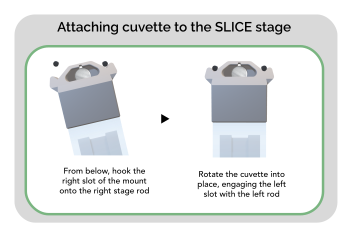
Attach cuvette to the SLICE stage.
-
Tilt the cuvette slightly and hook the right slot of the magnet mount onto the right stage rod from below.
-
Use the right rod as a pivot and rotate the cuvette clockwise until the left slot engages with the left rod.
-